Here's some circuits to try out - some complete projects, some add-ons - basically, some ideas or starting points. DIY! I've only been dealing with electronics for a few years and I only had a very little formal training. Everything has been picked up from books and the endless wealth of information on the internet. Oh, and by trying things out constantly - be busy! So I'm definitely still learning and making mistakes... Do get in contact if you spot an error in any of these designs or figure out an improvement because these designs are still in quite experimental states.
!NOTE! Please don't go selling anything based on these designs without asking first - I'm reasonable, hopefully you are too! |
![]() |
WorkshopOscMachine The W.O.M. is now available as a DIY kit from the shop. Absolutely ALL parts are included - all you need are a few tools (Soldering Iron / Solder / Wire Snippers) - plus full documentation on components, soldering, building and workings! Sonic details are on the SoundDevices page here. You can download the full documetation here |
CMOS Designs These simple circuits are meant to be quicky'n'dirty and make use of some of the wide variety of chips available in the 4000 CMOS logic series. The schematics generally just show the simplest possible setup for the chip (check out the datasheets for more info). Its an open ended system for experimentation - either at audio rates (for synthesis) or low freqs (for rhythmic clocking). Please share ideas/pictures/sounds at the electro-music.com forum! General notes: |
4089 Rate Multiplier CD4089 at TI.com |
PCB for Thomas Henry Quadrature Function Generator Refer to Scott
Stites' TH-QFG webpage for this project. |
Pattern Generator I began this 4052 based design as a core for micro-controlled sequencing, but my learning of the micros hit another wall so I thought I'd make a standard modular one to run off my clock divisions. Should be pretty straight forward - the 4052 is a dual 4 stage multiplexer -- use the two Bit inputs to select which input passes through to the output. So there's four pots (range 0 to +5v) to be selected and the 2nd half of the 4052 is used to provide a step LED indicator. The bit ports each have two inputs - these are each OR'd together - you could add more. |
| Electronic (foot)switch This is a simple circuit for an electronic switch - I'd designed this for an external footswitch module but also with a duplicate button panel mounted. There are enough gates spare to easily make a dual version. Output - 0v to +V Gate (switchable Mom or Tog), plus trigger signal (c. 1ms pulse) each time the button is switched. The input should be a momentary (normally open) switch to ground. |
PCB for Thomas Henry XR2206 VCO - PDF Document with PCB / Parts Placement / Schematic (813kb) Refer to Scott Stites' XR2206 VCO webpage for this project. This is a compact PCB for the great XR2206 VCO designed by Thomas Henry.
|
|
!Prototype info for personal use only! The BugCrusher - Audio rate Sample & Hold for Bit Crush
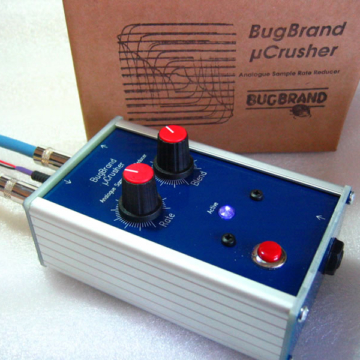
effects I'd wanted to make some sort of bit-crusher effect for ages, but never quite figured the way to use microprocessors or ADC/DACs. And then I came across the Analog Devices AD781 Sample & Hold Amp and it struck me that running this at audio rates would effectively give a simple means of changing the sampling rate - not true bit-crushing but it sounds great! The AD781 is very easy to implement. All you need is a 5v trigger pulse at whatever rate - this must, however, be of very narrow pulses, so I used a 40106 chip (with 5v supply) to make a narrow pulse osc. You also need to keep the pulses narrow to avoid signal bleed through. From this point I added a Voltage Controlled Resistor onto the circuit to make the Trigger Osc voltage controllable. These circuits were designed for my modular system - they run off a +/- 12v bipolar supply The 1st circuit is the simple stand-alone - simple & very effective. The 2nd circuit adds voltage control to the 1st circuit (along with some tweaks for the particular application). An LM13700 is used for a floating VC Resistor (resistor values found by trial & error!) and this is driven by a log converter based on a Ray Wilson Music From Outer Space schematic. I daresay there's some refinements possible - please get in touch if you have ideas on how to make this better.!. Steven Roeder has done a very compact stripboard layout for the stand-alone BugCrusher circuit - find it here |
This is preliminary info - while there's a load of potential in this project, I've always found that wierd (bad) sonic problems occur. I've shelved the project for now, but feel free to make use of the developments. ISD1416 Lofi Looper with Randomisation I first used this chip a few years ago in what I called the Dirty Sampler - great lofidelity looping. The circuit always had a few problems that I just couldn't sort out until I was pointed to the Mobius Trip design at General Guitar Gadgets (thanks to Colin Experimentalists Anonymous). By using Dean Hazelwanter's analogue front-end I finally overcame the problem of big-assed clicks when you start or stop playback. Great.!. From that point I redid the ISD1416 circuitry a little bit and, with the circuit working pretty well, tried out randomising the playback start point. The randomisation works as follows: whenever playback is started the states of the 8 address lines are read. So, create a bunch of squarewave oscillators to feed into the address lines and have them all running at different speeds - the sampling of the address on playback therefore appears as a pretty much random number and we get randomised playback. There's things to watch, though - if the 2 high address lines are both high then the chip goes into another mode. In the prototype I've made 6 oscs from a 40106 logic chip and fed these to a variety of address inputs, but always avoiding connecting both of the 2 high lines. This can, though, somewhat limit the range of randomisation - basically, the datasheet says the chip has 160 memory segments. (although I haven't quite figured how the memory is split up because I reckon logically there should be something like 192 possible address combinations.?. anyway, more things to look at.) So right now the circuit is definitely still in prototype stages. The schematics are a rough guide and the digital board in particular contains a few extra connections for my own test purposes. I daresay there's still a lot of scope for improving some of the component values. Notes: The ISD1416 needs to be clocked at a speed of somewhere around 1Mhz so a high speed 555 was used. The clocking will no doubt be one of the next areas to hone. |
Crackle Box Audio Output I wanted to take an audio output, but things seemed to behave strangely - I initially used a small audio transformer after the transistor amp stage on the original schematic, but this had some problems with ground hum loops (probably due to some incorrect methods.!.). I came back to the circuit a while later and tried a different approach - taking the signal from the output of the LM709, passing it through a simple buffer circuit and then using a transformer for output. |
|
| Notes: The input of this circuit is taken from the output pin (pin 6) of the LM709. I used a miniature audio output transformer rated at 20k primary, 1k secondary. The output ground connection is not connected to the circuit's ground and this extra circuit can leech power straight from some point on the main circuit. As with most component values, they can quite probably be changed / improve, but the circuit works for me so... | |
This is just a selection of my favourite links (ones I've found particularly useful). There's always going to be loads of other info about that I haven't included, so do carry on searching too... Synth DIY: Other Electronics: Useful Forums: Parts Suppliers: |